
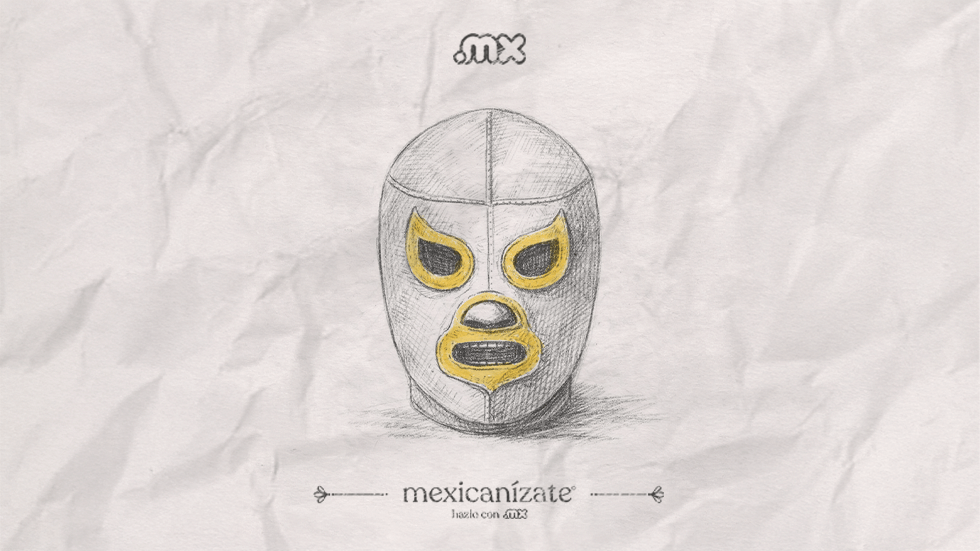
More than just a sport or entertainment, Mexican wrestling is a cultural phenomenon deeply rooted in the country’s identity. With its colorful masks, acrobatic moves, and blend of ritual, resistance, and theatricality, it has become a language of its own that is understood from neighborhoods to major international stages.
Born in popular spaces and embraced by generations, wrestling not only entertains: it tells stories. Stories of justice, ingenuity, daily struggle, and collective pride. Each performance projects emotions that go beyond the ring and connect with memory, neighborhood, and Mexican identity.
That is why talking about lucha libre is talking about something bigger than a fight. It is talking about community, shared symbols, and a tradition that has evolved without losing its essence.
The origin of a narrative: technicians, rudos, and the people
Since its inception in the 1930s, when Salvador Lutteroth founded the Mexican Wrestling Company (EMLL), now the World Wrestling Council (CMLL), this spectacle has distinguished itself by constructing a clear and deeply symbolic narrative.
The division between technicians and rudos not only organized the spectacle: it reflected a worldview. Good versus evil, justice versus cheating, the hero versus the antagonist. The audience does not just watch, it participates emotionally, takes sides, and recognizes itself in what happens in the ring.
Each match functions as a social representation where the values, tensions, and aspirations of the people clash. Perhaps that is why wrestling resonated with different sectors of society, because it speaks an emotional language that transcends age, class, and context.
Beyond the ring: an industry that drives economies
Over time, this cultural narrative has also transformed into a thriving industry. Behind the folklore and excitement lies an ecosystem that supports thousands of people. Wrestlers, promoters, referees, mask designers, tailors, photographers, chroniclers, merchants, and street vendors are all part of an economy that revolves around the arenas.
Weekly shows activate entire neighborhoods. The CMLL arenas alone register more than 12,000 new spectators each week, and between 30% and 50% of the Arena Mexico audience is made up of tourists. This makes wrestling a cultural meeting point and an experience that attracts national and international visitors.
On a larger scale, the global wrestling industry has a projected value of more than $7.38 billion, with an estimated annual growth rate of 4.8%. These figures confirm that wrestling not only preserves tradition: it generates employment, activates local economies, and projects Mexican culture abroad.
But beyond the numbers, this industry needed something more to transcend, symbols capable of representing its essence and turning it into legend.
El Santo: when wrestling became a myth
If Mexican wrestling managed to establish itself as a cultural phenomenon, it was thanks to figures who transcended the ring. None were as influential as El Santo, El Enmascarado de Plata (The Silver Masked Man).
El Santo was not just a successful wrestler. He was a popular hero, a star of Mexican cinema, and a moral reference point for entire generations. His mask became a symbol of justice, courage, and dignity. At a time when the country was looking for role models, El Santo embodied the everyday hero, the protector of the people.
His legacy did not remain in the past. El Hijo del Santo has continued that lineage with a career spanning more than 40 years, taking Mexican wrestling to stages in Japan, France, Germany, England, and the United States. Always with the mask as a banner of identity and national pride.
Thanks to these figures, wrestling ceased to be a local spectacle and became a universal narrative with deeply Mexican roots.
Wrestling in contemporary culture
This symbolic power allowed wrestling to expand beyond the arena. Today, it is part of cinema, fashion, music, contemporary art, and academia. It is studied in universities, exhibited in museums, and printed on clothing that circulates around the world.
Masks have become cultural icons. Local artisans produce pieces ranging from $200 to $1,000 pesos, combining tradition, design, and craftsmanship. Each mask is not just an object; it is a story that is worn and shared.
Thus, wrestling stands alongside other Mexican cultural expressions such as skulls and alebrijes, recognizable symbols that represent creativity, identity, and cultural resistance.
From the ring to the digital world: new audiences, new rules
Like many cultural industries, wrestling has had to adapt to changing times. Today, its survival and growth also depend on the digital environment.
Social media, streaming, and e-commerce have opened up new ways of connecting with audiences. The purchase and sale of digital tickets, the sale of merchandise online, and the creation of content allow wrestling to reach global audiences without losing its local character.
Wrestlers no longer just shine in the ring; they also build communities on digital platforms, share their stories, and strengthen their relationships with fans. This transformation does not replace the live experience, but it amplifies and projects it.
More than just entertainment, an expression of who we are
Mexican wrestling is a blend of past and present, of roots and reinvention. It is a mirror that reflects our passions, contradictions, and creativity. It represents Mexico’s ability to transform the popular into art and the local into something universal.
Its future lies not only in the arenas, but also in digital spaces, in new cultural ventures, and in the communities that form around this tradition. Because in the end, wrestling is not just a battle in the ring, it is a celebration of our identity.
And like many of the stories that define us as a country, it deserves to be told, shared, and projected with the domain that gives it meaning: .MX.